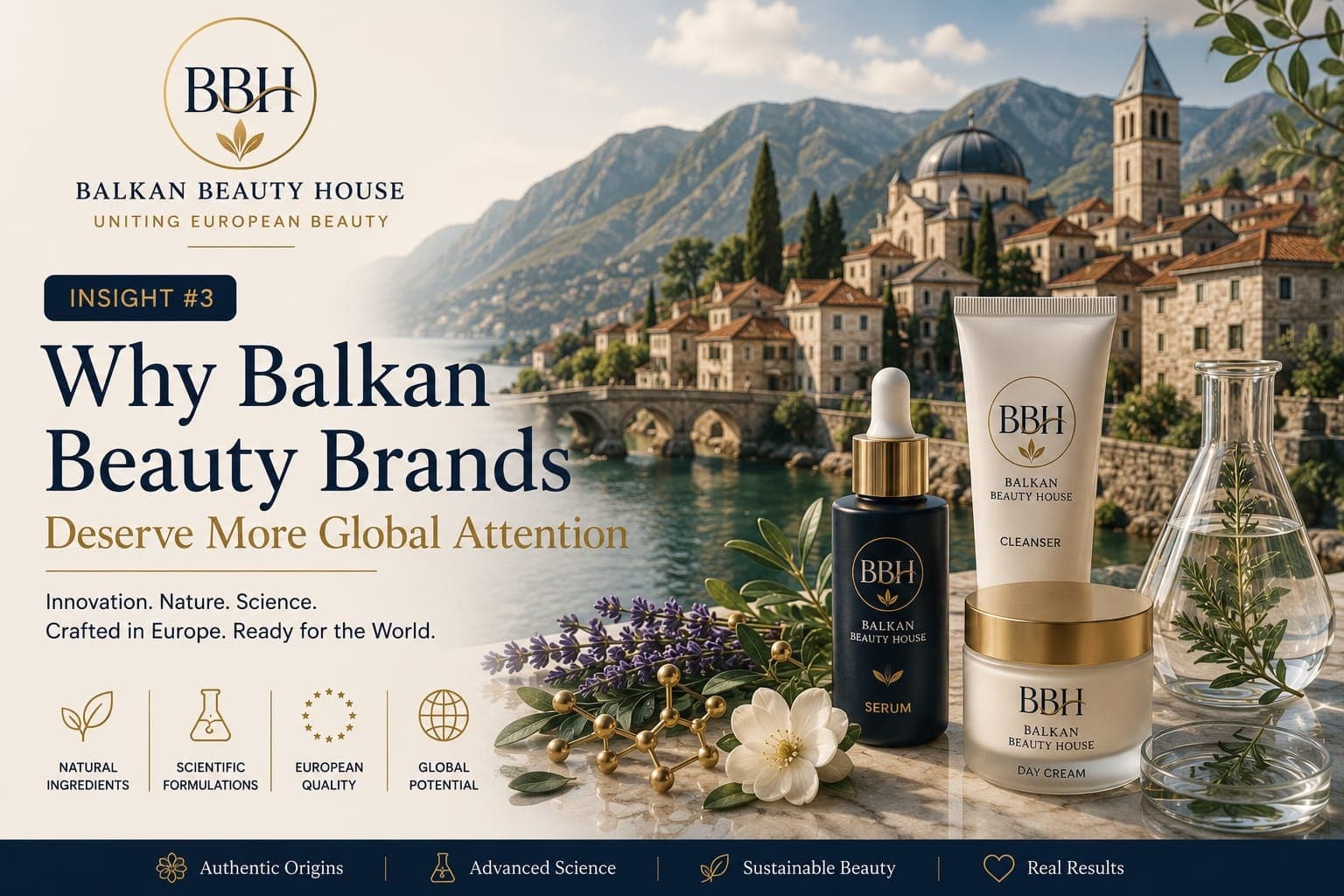
A Beauty Region Worth Watching
When international buyers think about European beauty, attention traditionally turns toward established markets such as France, Italy, Germany and the United Kingdom.
But Europe’s beauty landscape is broader than its traditional capitals.
Across the Balkans, a growing group of skincare, cosmetics and personal-care manufacturers is developing products that combine European manufacturing know-how with scientific formulation, natural ingredients and increasingly sophisticated brand identities.
Serbia provides a particularly interesting example. Recent analysis of its natural and organic cosmetics sector shows a highly entrepreneurial industry dominated by smaller producers. Serbian companies produced approximately 2.5 million units of natural and organic cosmetics in 2025 and developed 308 formulations, while almost one fifth of companies in the sector regularly export to international markets.
These numbers do not suggest that every Balkan beauty company is ready for international expansion.
They suggest something more interesting: The region has become a source of emerging beauty innovation worth exploring.
1. Innovation Is Not Limited to the Traditional Beauty Capitals
Smaller beauty manufacturers can sometimes move differently from multinational corporations.
They can focus on narrower consumer needs, develop specialized formulations and create product concepts around emerging ingredients or specific skincare concerns.
Earlier sector research in Serbia found that 93% of surveyed natural-cosmetics companies had introduced new products during the preceding three years, while 57% planned to expand production.
For international distributors, innovation from smaller manufacturers can provide access to brands that are differentiated rather than simply competing with the same globally established portfolios.
2. Science and Natural Ingredients Are Increasingly Meeting in the Same Product
Modern beauty consumers increasingly expect more than attractive packaging.
They want to understand formulations, active ingredients, product purpose and expected benefits.
This creates an interesting opportunity for manufacturers that can combine ingredient-led skincare with natural-product positioning.
Across Balkan beauty, these two ideas do not necessarily need to compete with each other. A brand can draw on botanical ingredients, regional identity and natural-product traditions while simultaneously using contemporary formulation science.
This intersection can be particularly relevant as skincare consumers become more knowledgeable and more interested in efficacy.
3. Smaller Manufacturers Can Offer Something Different
Scale is valuable—but so is agility.
Many emerging Balkan beauty businesses remain relatively small. For international partners, smaller scale can sometimes create advantages: closer communication with manufacturers, greater attention to individual markets and the possibility of building a brand internationally while it is still developing.
It can also allow a distributor to introduce something consumers have not already seen everywhere.
The objective is not to choose a brand simply because it is small.
The opportunity lies in identifying smaller brands with strong products, professional manufacturing and genuine international potential.
4. Croatia Shows Another Side of the Regional Beauty Story
The Balkan beauty opportunity is not limited to Serbia.
Croatia has a developed beauty and personal-care market with growing interest in skincare innovation, advanced formulations and wellness-oriented products.
The wider Croatian economy is also export-oriented, reinforcing a broader point: the region contains companies operating within increasingly sophisticated European consumer and export environments.
5. Distinctive Brand Stories Matter
International beauty shelves are crowded.
A new brand therefore needs more than acceptable quality. It needs a reason to be remembered.
Balkan brands can potentially draw on several sources of differentiation: regional botanical traditions, local ingredients, pharmaceutical expertise, founder-led businesses, specialized formulations and cultural identity.
But authenticity must be real.
The strongest brands are those able to translate their origins into a modern proposition without relying solely on geography as a marketing story.
Made in Europe may open the conversation. A distinctive product and credible brand must continue it.
6. Export Ambition Is Growing—but Selectivity Still Matters
One of the most interesting characteristics of the emerging Balkan beauty landscape is that internationalization is still developing.
For international distributors, that creates both opportunity and responsibility.
Some manufacturers may be excellent domestically but not yet prepared for international distribution. Others may already have the documentation, manufacturing capability, commercial structure and ambition required for expansion.
The opportunity therefore lies in careful selection, not simply discovering more brands.
The Next European Beauty Success Story May Come From Somewhere Less Expected
The global beauty industry has repeatedly shown that successful brands do not need to originate from the largest traditional markets.
Consumers increasingly discover products through ingredients, communities, digital content, professional recommendations and authentic brand stories.
That creates room for a new generation of European manufacturers.
The Balkans should not be viewed as a replacement for Europe’s established beauty centers.
They should be viewed as another source of European beauty innovation—one that international buyers, distributors and retailers may increasingly want on their radar.
Discovering the Next Generation of European Beauty
Balkan Beauty House explores opportunities with selected European and Balkan beauty brands seeking sustainable international growth and long-term market development in Iraq.