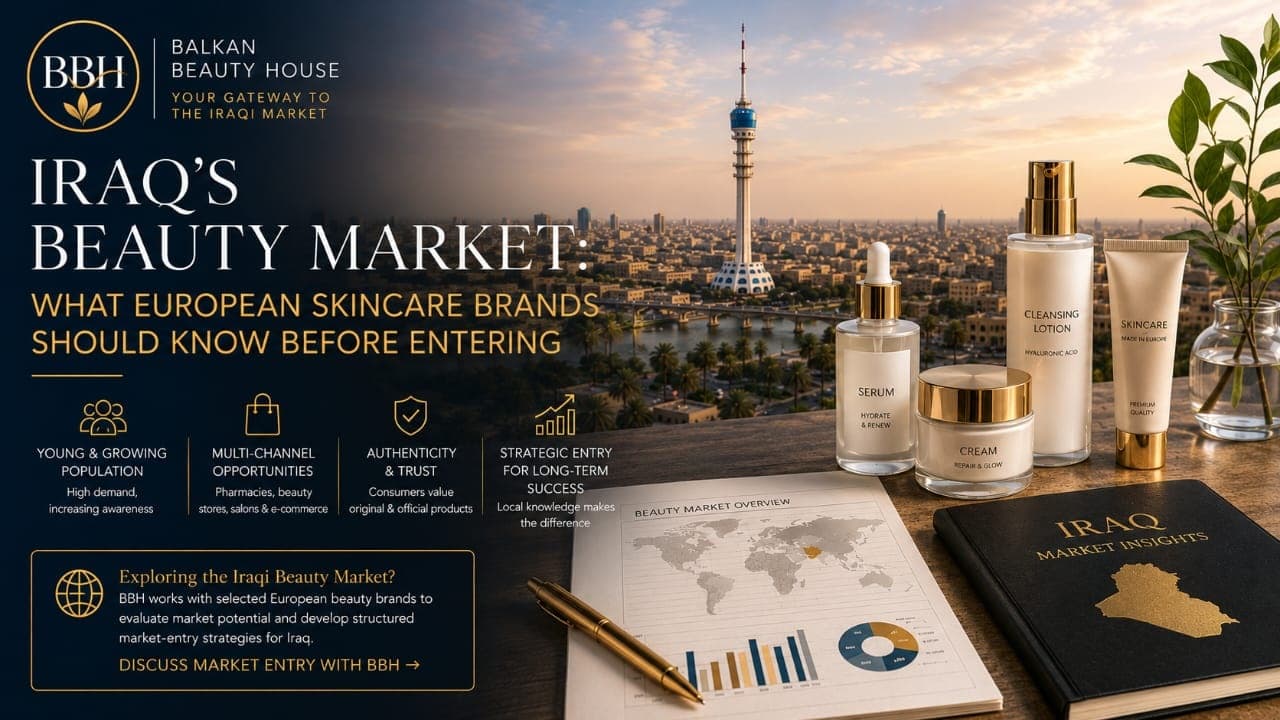
A Market Worth Understanding
Iraq’s beauty and personal-care landscape is evolving. Population growth, urbanisation, greater exposure to international beauty trends and changing attitudes toward skincare and self-care are creating new opportunities for differentiated international brands.
Recent market research identifies skincare among the prominent beauty categories in Iraq, while consumer behaviour is increasingly influenced by product performance, digital discovery and changing beauty routines.
For European skincare companies, however, opportunity should not be confused with easy market entry. Iraq is a market that needs to be understood before it is entered.
1. The Iraqi Consumer Is Becoming More Product-Aware
The beauty conversation is increasingly moving beyond basic cosmetics toward skincare routines, ingredients, efficacy and visible results.
Consumers are exposed to global trends involving vitamin C, hyaluronic acid, peptides, retinoids, barrier care, pigmentation solutions and other targeted skincare concepts.
This creates opportunities for European companies with scientifically positioned, differentiated products—but simply being European is not enough.
Brands need a clear answer to a fundamental question: Why should the Iraqi consumer choose this product?
Efficacy, formulation, credibility, positioning and education will increasingly matter alongside packaging and price.
2. Start With the Right Portfolio, Not the Entire Catalogue
One of the most important market-entry decisions is product selection.
Launching a complete European catalogue immediately may increase inventory requirements, regulatory complexity and marketing costs before actual local demand has been established.
A more disciplined approach is to begin with a focused group of hero products.
For Iraq, the strongest candidates may differ according to brand positioning, price and target consumer, but potentially attractive areas include hydration, pigmentation and brightening, anti-ageing, hair care, sensitive-skin products and ingredient-led facial care.
The objective is not to launch the largest possible portfolio. It is to launch the right portfolio, learn from market response, and expand intelligently.
3. Distribution Is Multi-Channel
Iraq should not be approached through one sales channel alone.
Pharmacies can be particularly relevant for dermocosmetics and science-led skincare because of the credibility associated with professional health channels. Beauty stores and specialist retailers provide discovery and comparison, while beauty centres can support professional recommendation and product education.
Digital commerce is increasingly important as well, developing alongside traditional retail channels.
The optimal channel strategy therefore depends on the brand. A clinical skincare brand may require a different distribution model from a lifestyle-oriented body-care or gift-set brand.
4. Digital Visibility Is Part of Distribution
In Iraq, digital presence is not simply a communications activity separated from sales. It increasingly influences product discovery, education and purchasing behaviour.
Recent digital-market data indicates that Iraq has a large and highly connected online population, with social platforms such as Instagram and Facebook playing an increasingly important role in consumer discovery and brand communication.
For a new skincare entrant, this means market development should combine physical availability with digital education.
Consumers need to understand what the product does, how it is used, what ingredients it contains and why they should trust it.
The brands that explain themselves well can have an advantage over brands that simply appear on a shelf.
5. Authenticity and Trust Matter
One of the most important challenges for international beauty brands entering Iraq is maintaining consumer trust.
The market includes fragmented supply structures, parallel imports and counterfeit products that can influence consumer confidence and brand positioning.
For an official European brand, this challenge can also become an opportunity.
A structured distribution model can create a clear proposition around authentic products, official supply, traceable sources and professional representation.
Over time, authenticity itself becomes part of brand value.
6. Pricing Requires Local Intelligence
European brands should avoid treating Iraq as a single undifferentiated premium market.
Purchasing power varies, competition is broad and parallel supply can distort consumer price expectations.
The appropriate retail price therefore needs to consider more than the European wholesale price. Freight, duties and import-related costs, regulatory requirements, distributor and retailer economics, competitor pricing, pack size and consumer willingness to pay all influence the final positioning.
The goal is not necessarily to become the cheapest brand. It is to establish a credible price-to-value proposition for the intended Iraqi consumer.
7. Regulation and Market Entry Must Be Planned Early
Cosmetics market entry involves more than commercial negotiation.
Product documentation, registration requirements, labelling, import procedures and compliance need to be considered before a launch portfolio and timeline are finalized.
This is particularly important when managing multiple SKUs. Regulatory readiness should therefore be part of product-selection strategy—not an administrative task left until the end.
Local Knowledge Changes the Equation
A European brand understands its products. A capable local partner understands how those products need to enter, compete and grow within the local environment.
Successful market entry therefore requires connecting both forms of knowledge. This includes selecting the initial portfolio, identifying appropriate channels, positioning prices, coordinating regulatory requirements, educating consumers, supporting retailers and measuring market response before scaling.
Iraq should not simply be treated as another export destination. It should be approached as a market to develop.